


You spend money driving traffic to your website. Google Ads, SEO, social media — all of it costs time, money, or both. But here’s the uncomfortable truth most business owners don’t want to hear: the vast majority of that traffic leaves your site without doing anything.
No call. No form fill. No purchase. Gone.
The average website converts somewhere between 2-4% of its visitors. That means 96-98% of the people you paid to attract just… bounce. And most businesses respond by throwing more money at traffic instead of fixing the real problem: their website doesn’t give visitors a reason to engage.
That’s where interactive calculators come in — and the data behind them is hard to ignore.
Interactive Content Converts at 2x the Rate of Static Content
This isn’t speculation. According to research from Mediafly, interactive content generates 52.6% more engagement than static content. Users spend an average of 13 minutes interacting with dynamic tools compared to just 8.5 minutes with traditional pages and blog posts.
Think about that for a second. People are spending over 50% more time on your site when you give them something to do instead of something to read.
And time on site isn’t a vanity metric. Google’s algorithm watches engagement signals like time on page and bounce rate. A visitor who spends 13 minutes using your ROI calculator signals to Google that your page is valuable — which means better rankings, which means more traffic, which means more leads. It’s a compounding loop.
Why Calculators Specifically? Because They Solve a Problem in Real Time
There are lots of interactive tools — quizzes, surveys, configurators. But calculators have a unique advantage: they answer the question your prospect is already asking.
“How much will this cost me?”
“What’s my potential ROI?”
“How much am I wasting right now?”
“What size system do I need?”
When someone lands on your website with a question like that and your site hands them a personalized answer in 30 seconds, something powerful happens. They stop browsing and start trusting. You just gave them value before asking for anything in return. That’s the foundation of every sale.
Here’s what the research shows calculators do for businesses:
- Lead generation machines — Gating calculator results behind an email capture converts at 2-4x the rate of a standard contact form, according to case studies from ConvertCalculator
- Qualification on autopilot — The inputs a user provides (budget, square footage, number of employees, etc.) tell you exactly how qualified they are before you ever pick up the phone
- SEO goldmines — Calculator pages earn backlinks naturally because other sites reference them as tools. They also rank for high-intent long-tail keywords like “roofing cost calculator” or “marketing ROI calculator”
- Trust builders — Transparency converts. When you show someone exactly how pricing works instead of hiding behind “call for a quote,” you eliminate the friction that kills most sales
Real-World Examples That Prove the Point
You’ve probably used a website calculator without even thinking about it. Mortgage calculators on bank websites. Shipping cost estimators on e-commerce stores. Insurance quote tools. These aren’t gimmicks — they’re conversion infrastructure.
Home services companies that add cost estimators to their sites see visitors engage longer and request quotes at higher rates. Instead of calling three competitors to compare prices, the homeowner gets an instant ballpark on YOUR site — and you’re now the first company they contact.
SaaS companies use ROI calculators to show prospects exactly how much money they’ll save or earn. ContentBeta’s analysis of ROI calculator examples found that quantifying a value proposition on-page directly increases the likelihood of a prospect requesting a demo.
E-commerce brands use product configurators and sizing calculators to reduce returns and increase average order value. When a customer is confident they’re buying the right thing, they buy faster and complain less.
The Numbers Don’t Lie: Engagement Drives Revenue
Let’s put this in dollars-and-cents terms.
Say your website gets 5,000 visitors per month and converts at 2%. That’s 100 leads. If your average customer is worth $2,000, that’s $200,000 in potential pipeline.
Now add a calculator that increases your conversion rate to even 3% — a modest lift based on the data. That’s 150 leads instead of 100. Same traffic, same ad spend, but $100,000 more in pipeline. Per month.
According to Algolia’s research, even small conversion rate improvements compound dramatically. A business doing $800,000/month in revenue could push past $1 million simply by improving on-site engagement tools.
The cost of building a calculator? A fraction of one month’s increased revenue. Which brings us to the question you’re probably already asking…
How Much Does It Actually Cost to Add a Calculator to Your Website?
This is where it gets interesting — because the answer depends on several factors. Your platform, your industry, how complex you need the tool to be, and who builds it all affect the price.
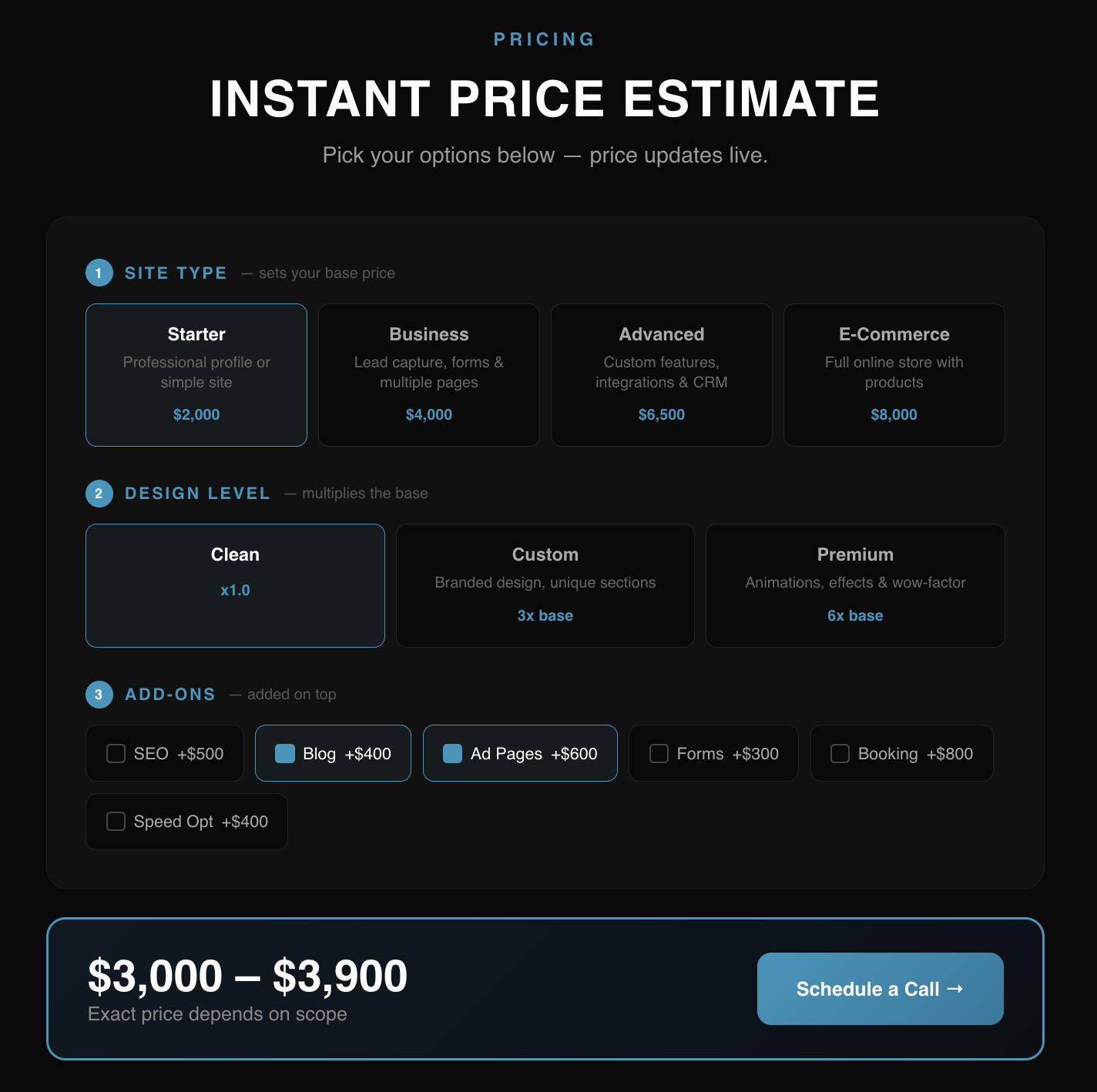
Rather than give you a vague “it depends,” we built a calculator to answer that exact question. (Yes, we practice what we preach.)
Use the tool below to get a personalized estimate based on your specific situation:
Website Calculator Cost Estimator
Find out what it would cost to add a conversion-boosting calculator to your site
1 What is your website built on?
2 What’s your business niche?
3 How complex should the calculator be?
4 How much monthly traffic does your site get?
5 Which features do you need?
What Factors Drive the Cost of Building a Website Calculator?
If you played with the estimator above, you noticed the price swings depending on your answers. Here’s why each factor matters:
Your Website Platform
WordPress sites have the most options — from free plugins like Cost Calculator Builder to fully custom-coded solutions. Shopify and Squarespace are more limited, often requiring custom embed code or third-party tools like Calculoid. And if your site is built on custom HTML or a framework like React, you’ll need a developer to build it from scratch — which costs more but gives you total control.
Your Industry / Niche
A simple “estimate your project cost” calculator for a landscaping company is straightforward. A HIPAA-compliant health savings calculator for a medical practice? That’s a different beast entirely. Finance and healthcare niches require compliance considerations, more complex formulas, and often legal review — all of which add cost.
Calculator Complexity
A 3-field calculator that multiplies square footage by a rate is a weekend project. A 20-field dynamic tool with conditional logic (where different inputs change what questions appear next), real-time pricing tables, and PDF report generation — that’s engineering work. The more fields, logic branches, and output formats you need, the higher the cost.
Build Method: Plugin vs. Freelancer vs. Agency
This is the biggest cost lever. A WordPress plugin might cost $0-150/year but comes with design limitations. A freelancer on Upwork might charge $500-2,500 for a custom build. An agency like us builds it as part of a conversion strategy — with design, copy, lead capture, CRM integration, and ongoing optimization baked in.
The right choice depends on your budget and how important the calculator is to your business. If it’s your primary lead generation tool, investing in a professional build pays for itself fast.
The Bottom Line: Calculators Pay for Themselves
Here’s what it comes down to. Every business with a website is already paying for traffic. The question is whether you’re squeezing every possible lead out of that traffic — or letting 97% of visitors leave empty-handed.
Interactive calculators work because they give people what they actually came for: answers. And when your website is the one providing those answers, you’re not just another option — you’re the obvious choice.
The data is clear. Outgrow’s research shows interactive content generates 52.6% more engagement. Conversion rates double. Time on site jumps from 8.5 minutes to 13. And every one of those metrics feeds directly into more leads, more sales, and more revenue.
The cost of adding a calculator to your site? Anywhere from free (with a plugin) to a few thousand dollars (for a custom build). The cost of NOT adding one? All the leads you’re currently losing to competitors who make it easier for prospects to get the answers they need.
Want a Calculator Built for Your Website?
At Imperium Marketing Solutions, we don’t just build calculators — we build conversion systems. Every calculator we create is designed to match your brand, capture leads, integrate with your CRM, and turn casual visitors into paying customers.
Whether you need a simple cost estimator or a complex multi-step configurator, we’ll design and build it as part of a strategy that actually moves your numbers.
Get a free quote — tell us what you need, and we’ll show you exactly what it’ll cost and what kind of ROI you can expect. No fluff, no obligation. Just a straight answer from people who do this every day.