
Four Gainesville businesses just got sued.
Not for anything they did. For something their website did — quietly, invisibly, on every single visit — without them even knowing it was happening.
The same South Florida law firm has filed identical lawsuits against 40+ Florida businesses and counting. A doctor’s office. Retail shops. Service businesses. Real people who woke up to a process server instead of a customer.
And here’s the part that should make you sit up: the thing they’re being sued over is on almost every business website in America.
We’re going to break down exactly what’s happening, why a 1969 wiretapping law is suddenly the hottest weapon in the lawsuit industry, why the cookie banner on your site probably won’t save you, and the 5-minute test that shows whether you’re a sitting duck.
Buckle up. This one’s a ride.
The Shakedown, Explained in 60 Seconds
Here’s the play, step by step:
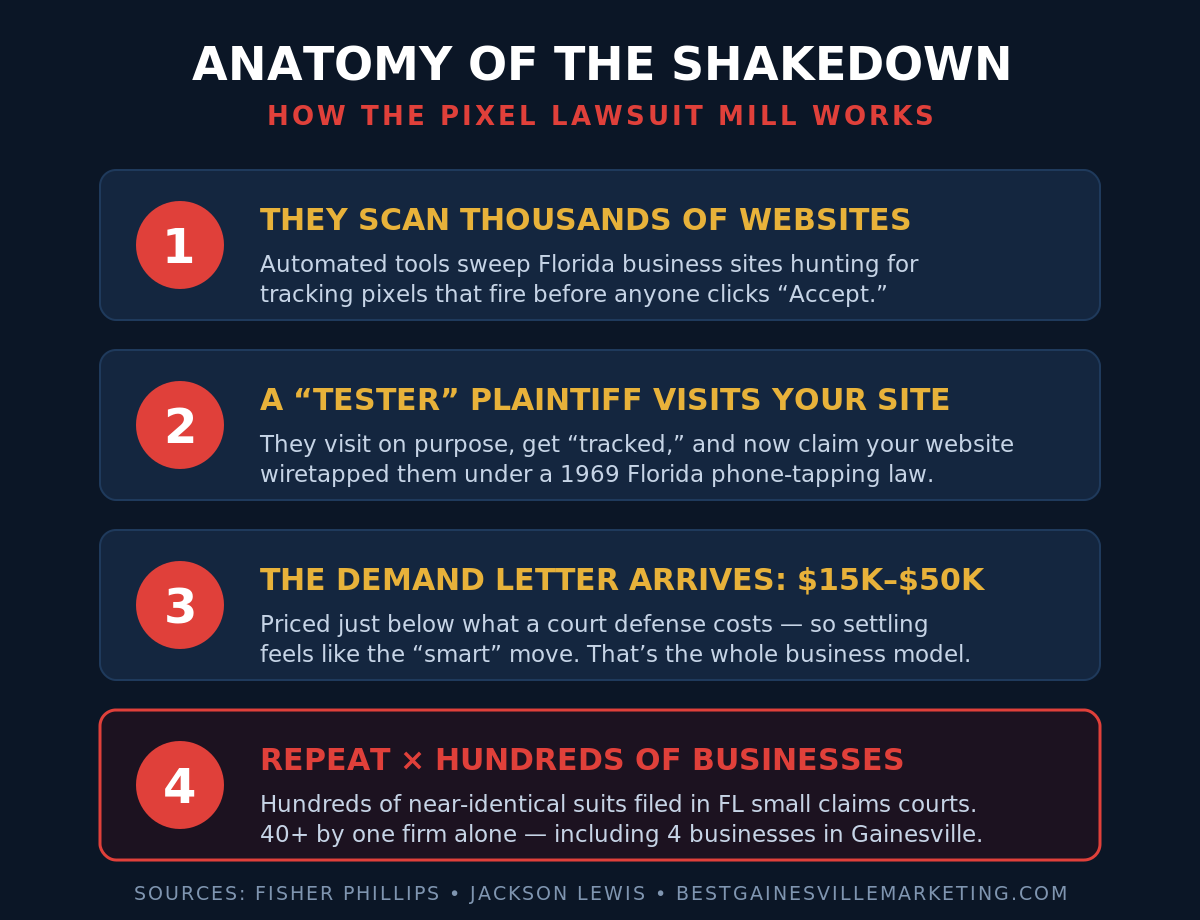
- A law firm scans thousands of Florida websites with automated tools — the same way we run marketing audits, except they’re hunting for lawsuits.
- They find a tracking pixel (Facebook/Meta Pixel, TikTok pixel, session recording, live chat widget — anything that sends visitor data to a third party) that fires before the visitor agrees to anything.
- A “tester” plaintiff visits your site on purpose. Congratulations — you just “wiretapped” them.
- You get a demand letter or a small-claims suit. Typical demand: $15,000 to $50,000. Carefully priced just below what it costs to fight it.
Multiply that by hundreds of businesses, and you’ve got one of the most profitable legal assembly lines in Florida right now.
This isn’t a conspiracy theory. Defense firms like Fisher Phillips — who defend businesses against these — describe Florida as “suddenly flooded” with digital wiretapping claims, with hundreds of nearly identical lawsuits filed in Florida small claims courts by the same firms using repeat “tester” plaintiffs.
Sound familiar? It should. It’s the exact same playbook as the ADA website lawsuit wave a few years back. Same economics, same targets, new law.
And this time the law has sharper teeth.
The Law: How a 1969 Wiretap Statute Became a Website Killer
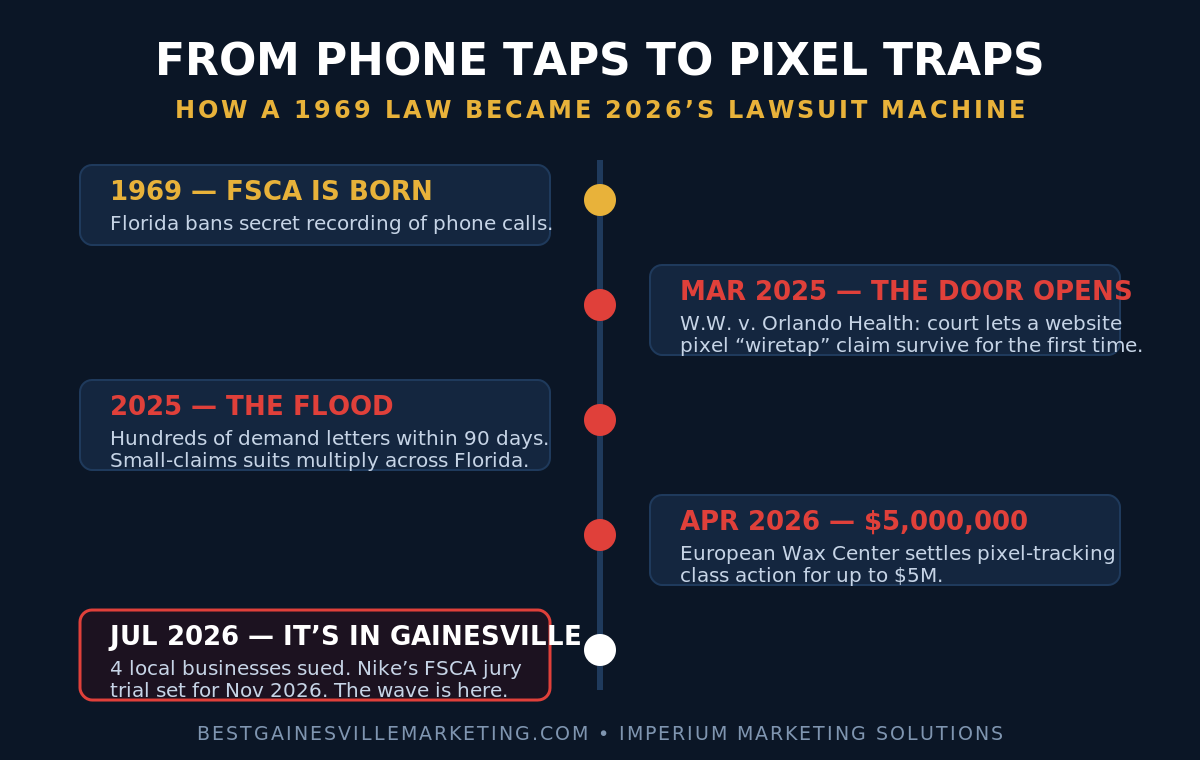
The weapon is the Florida Security of Communications Act (FSCA) — Florida Statute §934. It was written in 1969 to stop people from secretly recording phone calls.
Florida is an “all-party consent” state. Every person in a conversation has to agree before it can be recorded or intercepted. Reasonable rule for phone calls.
Now here’s the leap: plaintiff lawyers argued that when your website sends a visitor’s clicks, searches, form entries, and page views to Facebook via the Meta Pixel, your website is “intercepting” an “electronic communication” between the visitor and you — and handing it to a third party. Without consent, that’s a wiretap.
For years, Florida courts threw these cases out.
Then, in March 2025, a federal court in W.W. v. Orlando Health let one through. The court ruled the plaintiff had plausibly alleged that pixels capturing her healthcare browsing amounted to interception under the FSCA.
That single ruling kicked the door open. Within 90 days, plaintiff firms had sent hundreds of new demand letters. By 2026, the wave hit small claims courts across the state — and now it’s hit Gainesville.
The Math: Why They Ask for $15K–$50K (And Why People Pay)
The FSCA isn’t a slap on the wrist. It provides:
- $1,000 in statutory damages per violation (or $100 per day, whichever is greater)
- Actual damages on top
- Punitive damages are on the table
- They get their attorney’s fees paid — by you — if they win
Do the math on “per violation” and your stomach drops. Every visitor whose data got sent to Meta without consent is potentially a violation. A modest local website with 1,000 Florida visitors a month? That’s a theoretical exposure with two commas in it.
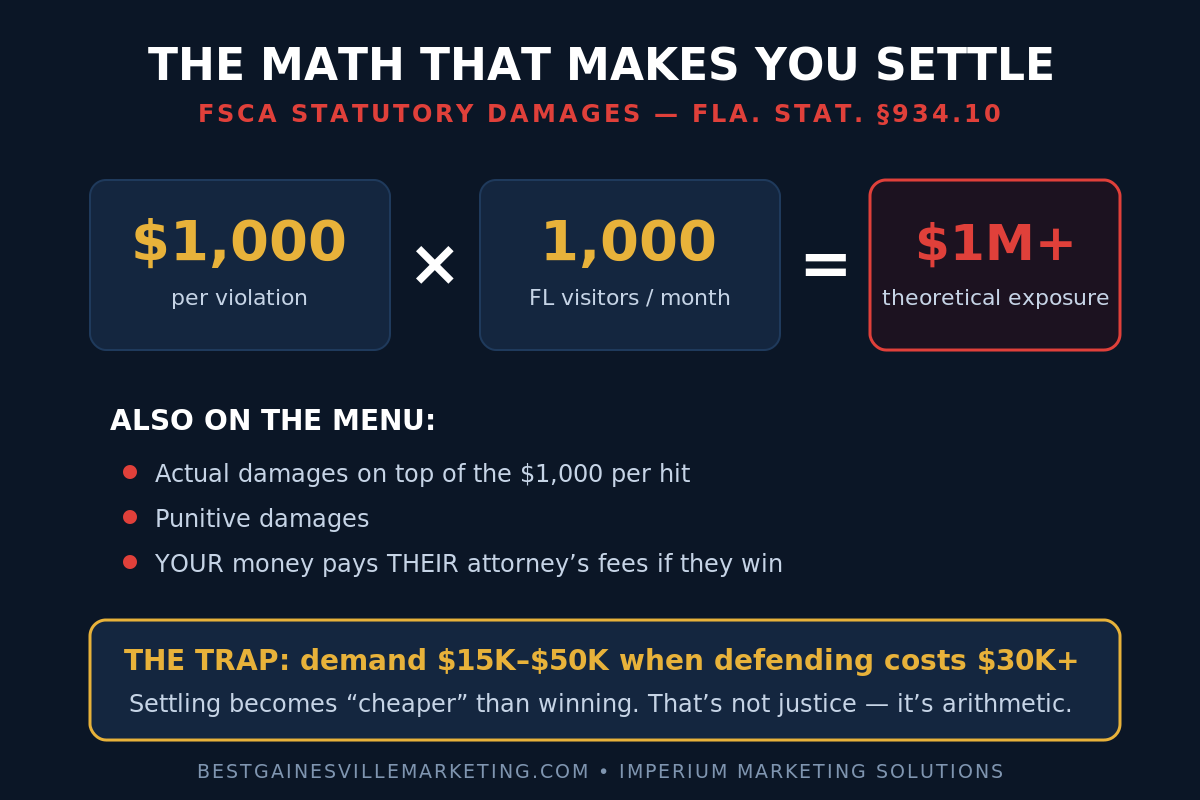
The lawyers know you’ll never pay millions. That’s not the point. The point is the demand letter says a scary number, your defense attorney quotes $30,000+ to fight it, and suddenly a $20,000 settlement feels like the smart move.
It’s not justice. It’s arithmetic. And it works — which is why they keep filing.
Think this only happens to big companies with deep pockets? Keep reading.
The Body Count So Far
European Wax Center — agreed to a $5 million class settlement (April 2026) after its website fired Meta, Snap, LinkedIn, and Attentive pixels without visitor consent.
Nike — Magenheim v. Nike is headed for trial in the Southern District of Florida in November 2026, the first big FSCA pixel case to reach a jury. Legal analysts’ takeaway: the first wave targeted healthcare, but Nike’s case proves any consumer-facing website is now a target.
Hundreds of Florida small businesses — the ones you never read about, because small claims settlements don’t make headlines. Med spas, dental offices, restaurants, retail shops, home service companies.
And now: four businesses right here in Gainesville, sued by one South Florida firm that filed 40+ identical suits across the state. We know because one of them told us directly — a local practice that had no idea the tracking was even on their website. Their web vendor installed it and never said a word.
Let that sink in: you can get sued for a pixel you didn’t know existed, installed by a company you paid to help you.
“But I Have a Cookie Banner!” — Why That Probably Won’t Save You
Here’s where it gets really uncomfortable.
Most of the businesses getting sued had a cookie banner. The little bar at the bottom: “We use cookies. Accept / Decline.”
They lost anyway. Here’s why.
The banner was decorative. The pixels fired the instant the page loaded — before anyone clicked anything. The banner was a costume, not a control. Plaintiff lawyers prove this in about 30 seconds with a browser’s network inspector, and it’s the single most common fact pattern in these cases.
“By continuing to browse, you agree” doesn’t count. Florida courts have repeatedly rejected implied consent. The FSCA requires prior, informed consent — the visitor must be told what’s collected, by whom, and why, and must actively agree before a single non-essential tracker fires.
And here’s the killer nobody talks about: the Decline button is often fake. We’ve tested sites where clicking “Decline” hides the banner… and the pixels keep firing anyway. That’s arguably worse than no banner — now there’s evidence you knew consent mattered and tracked people who explicitly said no.
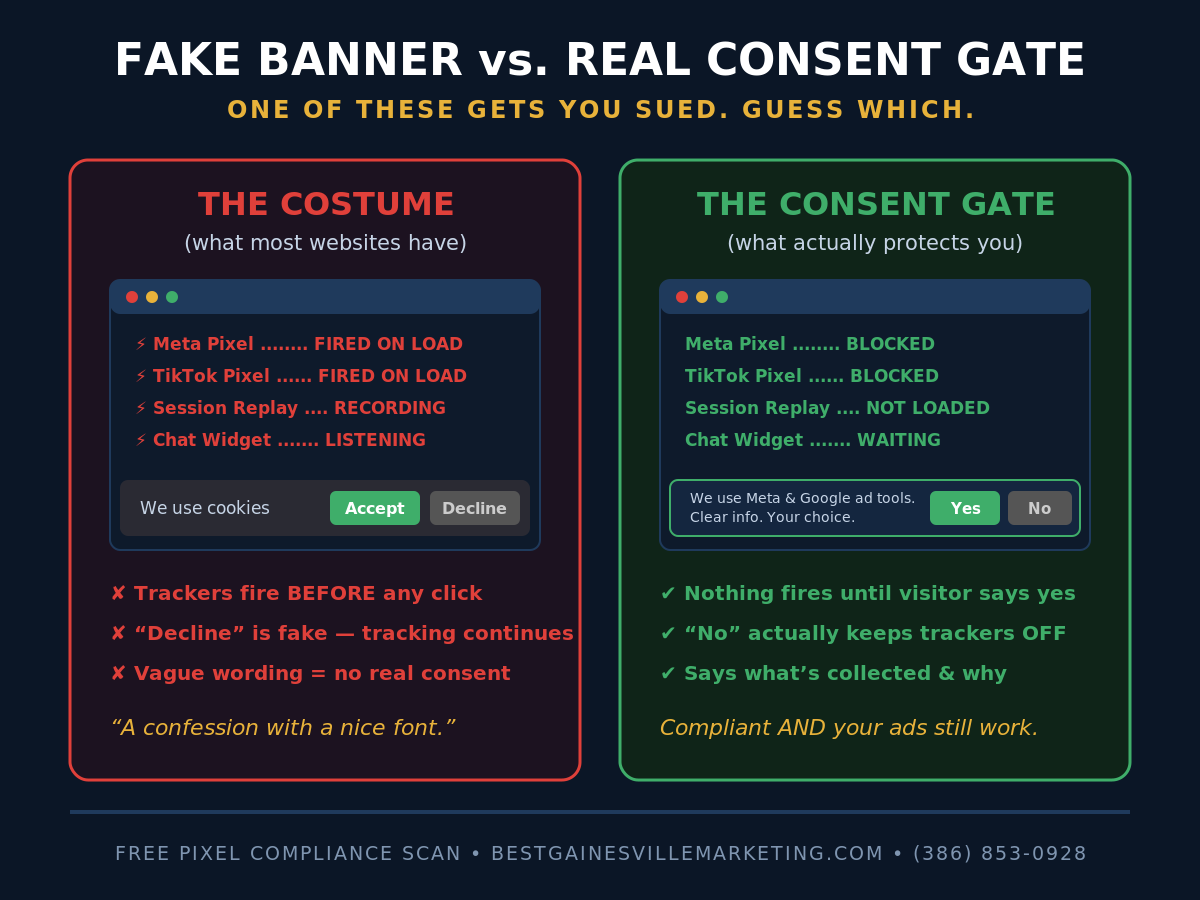
A cookie banner that doesn’t actually block tracking isn’t compliance. It’s a confession with a nice font.
What an Actual Fix Looks Like
Real protection has three layers, and all three have to work:
1. Script-level blocking. Every non-essential tracker — Meta Pixel, Google remarketing tags, TikTok pixel, session recording, chat widgets — gets moved behind a consent gate. Nothing fires until the visitor says yes. Not hidden. Not loaded. There’s a technical difference, and it’s the difference that decides lawsuits.
2. Informed consent language. The banner has to actually say what’s being collected and who it’s shared with. Generic “we use cookies to improve your experience” doesn’t meet the FSCA standard.
3. A Decline that actually declines. If someone says no, the trackers stay off. Verified, not assumed.
Now, the marketer in us has to be honest about the tension here: those pixels are how your Facebook ads find customers and how your Google Ads campaigns get smarter. Turn them off for everyone and your marketing takes a hit.
The answer isn’t ripping the pixels out. It’s a consent experience designed so most visitors happily click Accept — clear, prominent, front-and-center, with the value exchange obvious — while the plumbing behind it is genuinely compliant for those who don’t. That’s the intersection of legal protection and marketing performance, and it’s exactly the kind of problem a marketing agency should be solving, not just a law firm.
Compliance that kills your ad campaigns is a bad fix. Ad campaigns that get you sued are a worse one. You need both. That’s the whole game.
The 5-Minute Test: Is Your Website a Sitting Duck?
You can check your own exposure right now:
- Open your website in Chrome in an incognito window.
- Before clicking anything, press F12 (or right-click → Inspect) and open the Network tab.
- Reload the page. In the filter box, type facebook.
- See requests to
facebook.comorconnect.facebook.netbefore you’ve clicked Accept on anything? Your pixel is firing without consent. Trytiktok,doubleclick, andhotjartoo. - Bonus round: click Decline on your cookie banner (if you have one), browse a page, and watch the Network tab. Still seeing tracker requests? Your Decline button is decorative.
If you failed either test, you’re exactly what those scanning tools are hunting for.
If that made your stomach drop — good. It means you understand the situation. Now here’s the easy part.
Get a Free Pixel Compliance Scan (Before Their Scanner Finds You First)
We’re Imperium Marketing Solutions — a Gainesville web design and Google Ads agency. We build sites and run ad campaigns for a living, which means we live in these pixels every day. We know what they do, where they hide, and how to gate them properly without wrecking your marketing.
When this lawsuit wave hit our own backyard, we made a decision — the same one we made during the ADA website lawsuit wave: every website we’ve ever built is getting a working consent gate. Free. Even if you bought your site from us in 2010. That’s what it means when your website people actually stand behind their work.
If your site came from somewhere else, here’s what we’ll do at no charge:
The Free Pixel Compliance Scan. We’ll inspect your website exactly the way plaintiff law firms do — every tracker, every pixel, every widget — and we test whether trackers fire before consent AND whether your Decline button actually works, because a fake Decline is the trap almost everyone misses. You get a plain-English report: exposed, or protected. No jargon, no scare tactics, no obligation.
If you’re exposed, we’ll tell you exactly what the fix costs and how fast we can install it — usually days, not weeks. If you’re clean, we’ll tell you that too, and you can sleep at night.
Or call us at (386) 853-0928.
The law firms have scanners running right now. The only question is whose report lands first — theirs or ours.
This article is for general information, not legal advice. If you’ve already received a demand letter or been served, talk to an attorney — and then call us about fixing the underlying problem so it never happens again.
Sources
- Fisher Phillips — Is Florida the New Hotbed for Digital Wiretapping Lawsuits?
- Jackson Lewis — Florida’s Digital Wiretapping Surge: FSCA Litigation
- Sidley — Florida Federal Court Puts FSCA in Play in Website Privacy Class Actions
- National Law Review — Tracking Pixel Litigation Expands: State-by-State Guide
- ClassAction.org — European Wax Center $5M Pixel Settlement
- Enzuzo — Florida Security of Communications Act (FSCA) Explained
- Kelley Kronenberg — Live Chat & FSCA Exposure