

Choosing between google ads vs facebook ads gets expensive fast when the wrong channel eats your budget for three months and hands back weak leads, vague reports, and a lot of excuses. For most local service businesses in 2026, Google Ads is the better first bet because it captures people already looking for help, while Facebook Ads usually works better as a support channel for awareness, retargeting, or offers that need more convincing.
Google Ads vs Facebook Ads at a Glance
Google Ads and Facebook Ads both sell attention, but they do it in completely different moments.
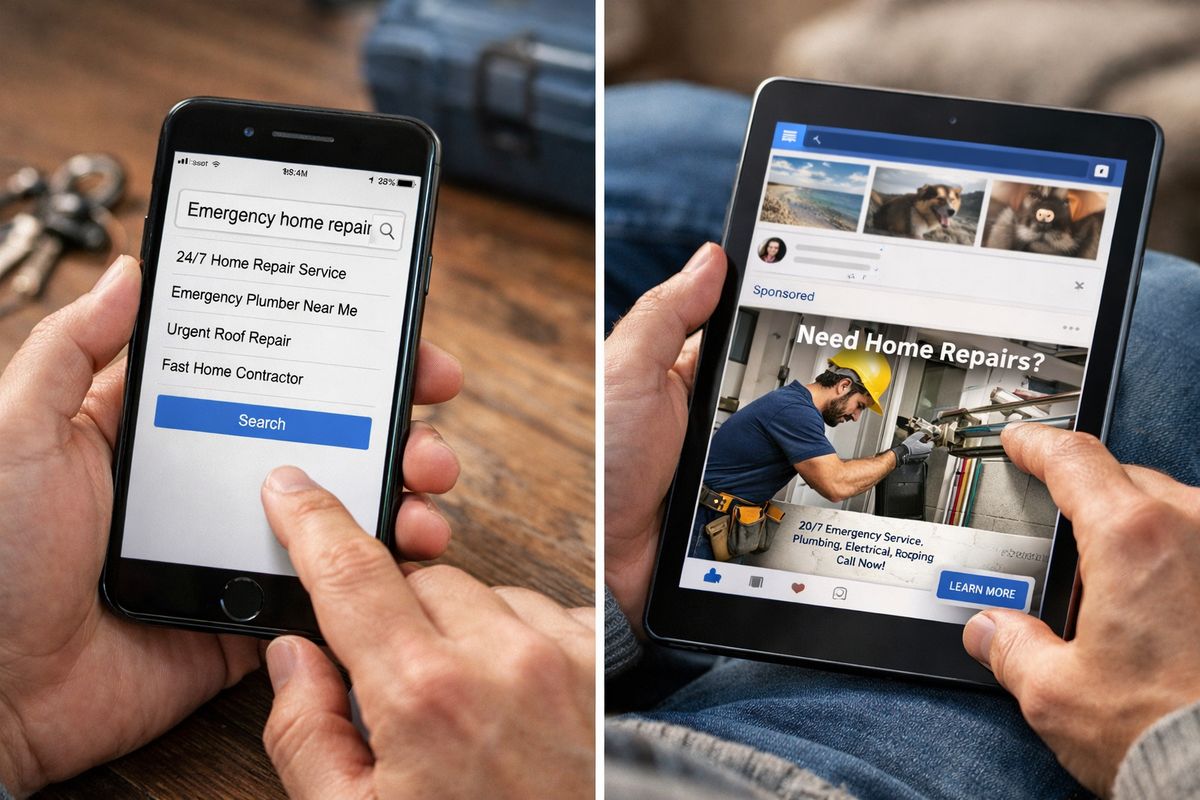
Google Ads puts your business in front of people who are actively searching. Someone types “roof repair Gainesville” or “AC repair near me,” sees your ad, clicks, and often wants to solve a problem today. That is bottom-of-funnel demand, meaning the person is already close to calling, booking, or requesting an estimate.
Facebook Ads works more like interruption marketing. Your ad appears while somebody is scrolling photos, watching short videos, or catching up with friends. The person did not ask for your service in that moment. Your job is to make the offer interesting enough to stop the scroll and create interest.
That difference matters more than any feature list.
If your business depends on inbound leads from people who already know they need help, Google usually fits better. If your business needs to create awareness, stay visible for weeks, or sell something people do not wake up searching for, Facebook can be a strong channel. Plenty of businesses need both, but very few should start with both at the same time.
Here is the simple version:
| Factor | Google Ads | Facebook Ads |
|---|---|---|
| User mindset | Searching for a solution | Browsing and discovering |
| Best for | Direct lead capture | Awareness and nurturing |
| Typical intent | High | Lower to medium |
| Creative demand | Moderate | High |
| Speed to bottom-funnel leads | Faster | Slower |
| Tracking clarity | Usually stronger | Often messier |
| Best first channel for local services | Usually yes | Usually no |
The Core Difference: Intent vs Discovery
The biggest split in google ads vs facebook ads is intent.
Google reaches people based on what they search. Facebook reaches people based on who the platform thinks should see your message. One is demand capture. The other is demand creation or demand shaping. That sounds abstract until money is on the line.
Intent changes lead quality because a search like “emergency plumber Gainesville” tells you a lot. The person has a problem, knows it, and wants a fix now. A Facebook user seeing a plumbing ad while waiting in line at a coffee shop may fit the right homeowner profile, but that does not mean a pipe is leaking today.
Intent also changes speed. Search campaigns can start producing useful lead data quickly because the buying signal is already there. Facebook often needs stronger offers, better visuals, more testing, and more follow-up before results settle into something predictable.
It changes budget too. You usually pay more per click on Google because the clicks are worth more. On Facebook, clicks can look cheap, but cheap curiosity is not the same thing as a booked job.
And it changes what kind of advertising wins. Google rewards relevance and clarity. Facebook rewards creative that grabs attention and builds trust in seconds.
If your business lives or dies on ready-to-buy leads, intent should drive the decision.
Audience Targeting
Both platforms can target specific people, but they start from opposite directions.
Google starts with the search. The platform asks, “What is this person looking for right now?” Facebook starts with the profile and behavior. It asks, “Who is this person, and what might catch attention?”
That makes Google especially strong for immediate-need services and Facebook stronger for interest-based discovery, promotion, and follow-up. Targeting on both platforms has changed over the past few years, mostly because privacy rules and platform automation have reduced some of the old hyper-granular options. You still have control, just not the kind of laser pointer some advertisers remember from years ago.
For local businesses and home service companies, this actually simplifies things. You do not need a thousand micro-audiences. You need the right message in front of the right person at the right moment.
Google Ads Targeting
Google Ads targeting revolves around keywords, match types, locations, and intent signals.
Keywords are still the backbone. If somebody searches “metal roof replacement,” “best med spa Gainesville,” or “water heater repair near me,” your ads can show for those queries. Match types help control how tightly Google sticks to your target phrases, though 2026 campaigns still need close monitoring because automated matching can wander into junk traffic if left alone.
Location targeting matters a lot for service businesses. You can target cities, ZIP codes, radiuses, or service areas, which is especially useful if your team only wants leads from Gainesville, Ocala, Lake City, or specific counties across North Central Florida. That said, settings alone do not solve everything. Search terms and user location signals still need regular review.
Audience signals also help. In-market audiences, remarketing lists, and customer data can sharpen campaigns, but search intent does most of the heavy lifting. That is why Google tends to work so well for urgent services. Somebody searching for your service is already raising a hand.
The catch is that Google can waste a lot of money if account structure is sloppy. Loose keyword targeting and poor search term control are often where budgets leak, which is exactly why cutting irrelevant traffic before it drains spend matters so much in local lead gen accounts.
Facebook Ads Targeting
Facebook Ads targeting is built around audiences, interests, behaviors, demographics, geography, and remarketing.
You can still target homeowners in certain age ranges, income brackets in some markets, broad interest clusters, or people who engaged with your business before. Platform automation has pushed advertisers toward broader audience setups over time, and in many cases that is fine. Facebook often performs better when you give the algorithm room to learn, as long as your creative and offer are strong.
Retargeting is where Facebook stays especially useful. If somebody visits your site, watches your video, or clicks an ad but does not convert, Facebook can keep your business visible while that person keeps thinking it over. That repeated visibility is valuable for longer sales cycles, financing-heavy offers, and services where trust matters.
Geographic filters still work well for local campaigns, though not with the same moment-of-need precision you get from search. A roofing company can target homeowners within a service radius, but the ad still needs to create interest, not just capture it.
Lead Quality and Buyer Intent
Lead quality is where the argument usually gets settled.
Google leads are often better because the person started the conversation. Facebook leads can bring volume, but volume is not the same thing as sales readiness. If your office has ever chased a stack of form fills that never answer the phone, you already know this difference in your bones.
That does not mean Facebook leads are bad. It means they usually require more filtering, faster follow-up, and a stronger sales process. Google leads tend to arrive with clearer intent and less explaining needed upfront.
When Google Leads Tend to Convert Better
Google wins when urgency is part of the buying decision.
Think emergency plumbing, HVAC breakdowns, legal help, roofing after a storm, locksmith services, or any search with “near me,” “same day,” “repair,” or “estimate” in it. A person searching at 8:12 a.m. in Gainesville for “AC repair near me” is usually not browsing for fun. The system is down, the house is getting hotter, and a phone call is coming soon.
That urgency shortens the path from click to booked job. It also improves close rates because the need is already real. If you serve homeowners, patients, or local customers with a direct problem to solve, Google usually sends better opportunities.
This is also why Google works well for businesses that care about accountability. Calls, forms, search terms, and landing page performance are easier to connect to actual revenue than social engagement metrics. If you have been burned by fuzzy reporting before, that clarity matters.
When Facebook Leads Still Make Sense
Facebook makes more sense when the buyer needs a nudge, some education, or repeated exposure before taking action.
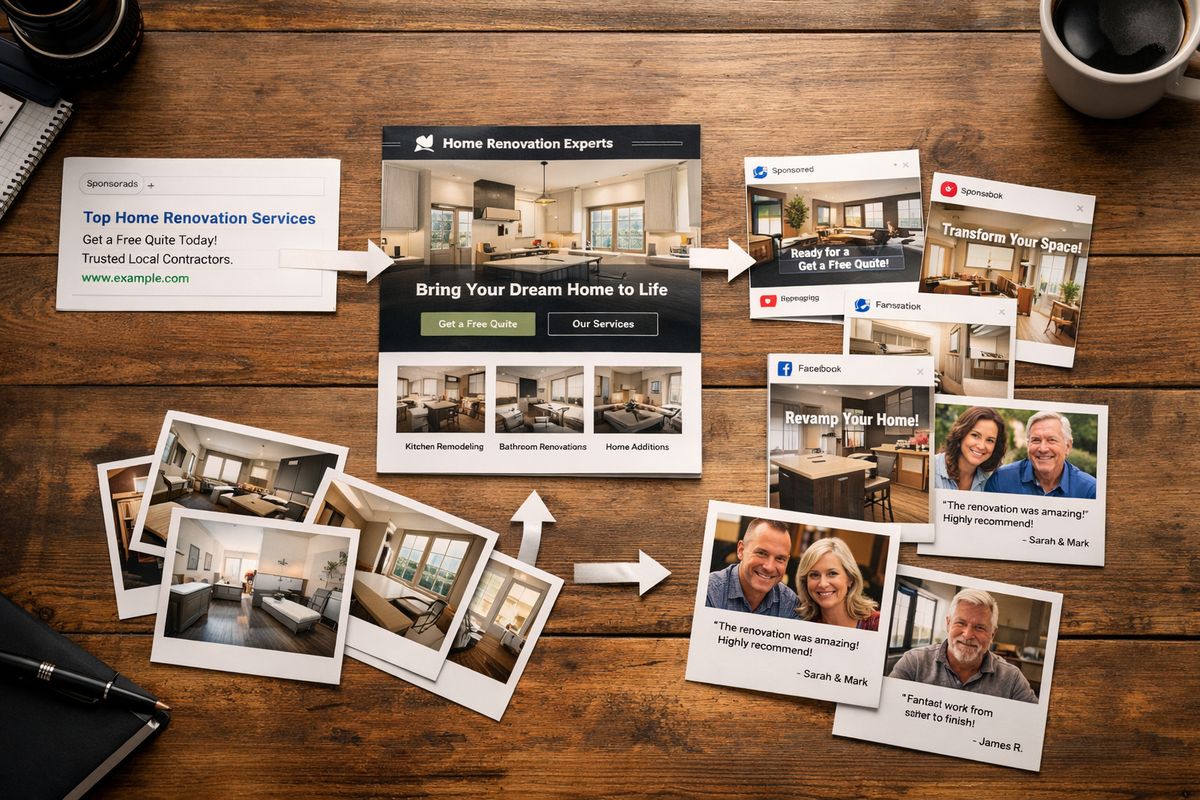
Remodeling is a good example. So are med spas, cosmetic dentistry, elective services, event-based promotions, and financing-led offers. Before-and-after photos, testimonial clips, seasonal deals, and payment-plan messaging often play better in a scrolling environment than inside a plain search result.
Facebook is also useful when people do not know what to search yet. Nobody opens Google and types “maybe I should finally remodel the bathroom this spring” with the same frequency as “roof leak repair.” Discovery channels shine when the offer is visual, emotional, or tied to aspiration rather than immediate pain.
The catch is follow-up. Facebook lead forms can generate a decent pile of names quickly, but if your team does not call fast and qualify hard, a lot of that volume fades.

Cost Per Click, Cost Per Lead, and Budget Efficiency
A cheaper click is nice. A profitable customer is better.
Google usually has higher cost per click, especially in competitive local service categories. Facebook usually has lower CPC and often lower CPM than a high-intent search campaign. On the surface, Facebook can look like a bargain.
But cost per lead is only part of the story, and cost per booked job matters more than both. A $15 lead that never answers is more expensive than a $90 lead that turns into a $9,000 project.
Why Google Usually Costs More Up Front
Google costs more because the traffic is closer to buying.
If multiple contractors want the same “roof replacement near me” search, bids go up. That is normal. High-intent search inventory is limited, and local competition can get intense fast in roofing, legal, HVAC, plumbing, and other lead-gen categories.
Still, higher click costs can work beautifully when the downstream numbers are healthy. If your landing page converts, your office answers calls, and your sales process closes well, expensive clicks can still produce strong ROI.
The problem is underfunding. Too many businesses give Google a tiny budget in a competitive market, then assume the platform failed. In reality, the campaign never had enough data or coverage to breathe. If you want a clearer sense of what spend and management usually look like, this breakdown of what businesses typically pay for serious campaign oversight helps separate realistic budgets from wishful thinking.
Why Facebook Can Look Cheaper Than It Really Is
Facebook often wins the beauty contest on front-end metrics. Lower clicks. Lower lead costs. More form submissions. More reach.
Here’s the thing: a lot of those numbers can flatter a weak campaign.
Lead forms inside Facebook are convenient, which means people submit them with less commitment. That convenience can lower quality. You may get more “just checking” leads, more no-shows, and longer sales cycles. If your team is not set up for speed-to-lead and persistent follow-up, those cheap leads become expensive fast.
That is why budget efficiency should be measured against booked appointments, sold jobs, and actual revenue. Vanity metrics are easy to celebrate. Payroll is less impressed.
Speed to Results
Google usually gets to useful results faster.
If search volume exists and your targeting is tight, you can start seeing qualified clicks and lead activity relatively quickly. That does not mean instant perfection, but the feedback loop tends to be shorter because the intent signal is strong from the start.
Facebook often needs more runway. Creative testing takes time. Audience learning takes time. Offer refinement takes time. A campaign may need several versions of images, videos, headlines, and landing experiences before performance stabilizes.
For a local business that needs the phone to ring, that speed difference matters. If you need leads this month, not just “brand lift” eventually, Google has the edge.
Ad Formats and Creative Demands
Google and Facebook ask very different things from your marketing.
Google is mostly about message match. The search, the ad copy, and the landing page need to line up cleanly. Facebook is about interruption. You need a visual, a hook, and enough proof to make a distracted person care.
That means Facebook usually demands more creative output and more frequent refreshing. Google demands sharper thinking about intent and conversion paths.
Google Ads Creative Requirements
Google Ads creative is less flashy, but not simpler.
You still need strong headlines, clear descriptions, relevant extensions, and a landing page that makes the next step obvious. If somebody searches “screen room contractor Gainesville,” the ad should talk about screen rooms, the page should talk about screen rooms, and the form should make it easy to request an estimate. Sounds obvious, but plenty of accounts send highly specific searches to generic homepages and then wonder why conversion rates sag.
Fast load times, simple offers, and clean layout matter more here than fancy visuals. Search users already told you what they want. Your job is to confirm you are the right answer.
Facebook Ads Creative Requirements
Facebook demands stronger creative because the ad has to interrupt behavior, not just match it.
Images need to catch the eye. Video needs to hook quickly. Copy needs to open with something that feels relevant right away, maybe a financing offer, a seasonal pain point, or a before-and-after transformation. Social proof helps a lot because people are naturally skeptical while scrolling.
Creative fatigue is also real. An ad that performs well in month one can go stale in month two because the same audience keeps seeing it. That means more production, more testing, and more ongoing maintenance than many business owners expect.
If your business does not have the bandwidth to create fresh creative regularly, Facebook gets harder to run well.
Funnel Fit: Awareness, Consideration, and Conversion
Google usually performs best at conversion. Facebook usually performs best at awareness and consideration.
That makes Google the better tool for capturing existing demand. If somebody already wants a roofer, attorney, med spa consultation, or AC repair, search is where that demand shows up. Facebook can still help convert warm traffic through retargeting, but it is rarely the cleanest first-touch channel for urgent lead capture.
Facebook shines earlier in the funnel. It can introduce your business, show your work, build familiarity, and keep your name in front of people who are interested but not ready. That is especially valuable when the buying process takes weeks or months.
If your pipeline is empty right now, conversion comes first. If you already have some traffic and need more visibility around your offer, Facebook starts making more sense.
Local Businesses vs National Service Areas
Geography changes the answer.
A local radius-based business has very different needs than a home services brand trying to feed several markets at once. Google and Facebook can both work in either case, but the balance shifts.
Best Fit for Local Gainesville and North Central Florida Businesses
For local businesses that depend on phone calls, estimates, and map-driven behavior, Google should usually be the first channel.
A dentist in Gainesville, a roofer in Alachua County, or an HVAC company serving Ocala and Lake City benefits from search intent because local customers often start with Google when the need is concrete. Search and Maps behavior naturally favor businesses that show up at the exact moment somebody is looking.
That directness is hard to beat. If your job calendar depends on local lead flow, Google gives you a straighter line from search to contact. Facebook can support it, but it usually should not replace it.
Best Fit for Regional and National Home Services Brands
As service areas expand, Facebook becomes more useful.
A regional roofing brand or national home services company often needs broader awareness across multiple cities, repeated visibility, and retargeting that follows prospects through a longer consideration cycle. Search still matters in every market, but Facebook can help warm up colder audiences at scale, especially when storms, financing offers, or seasonal demand create a reason to pay attention.
For multi-market growth, the strongest setup is often search for high-intent capture plus paid social for nurture and repeat exposure. One gets the hand-raisers. The other keeps your brand in the room.
Tracking, Attribution, and Knowing What Actually Worked
This is where a lot of agency reporting gets slippery.
Pretty dashboards do not mean much if you cannot tell which channel produced calls, booked appointments, and closed revenue. In 2026, privacy changes, platform modeling, and weak CRM hygiene still make attribution imperfect. But imperfect is not the same as impossible.
Google is generally easier to track cleanly. Facebook is still trackable, but the path tends to be messier because the user journey is longer and less direct.
Google Ads Tracking Strengths
Google Ads has an advantage because the conversion path is usually more linear.
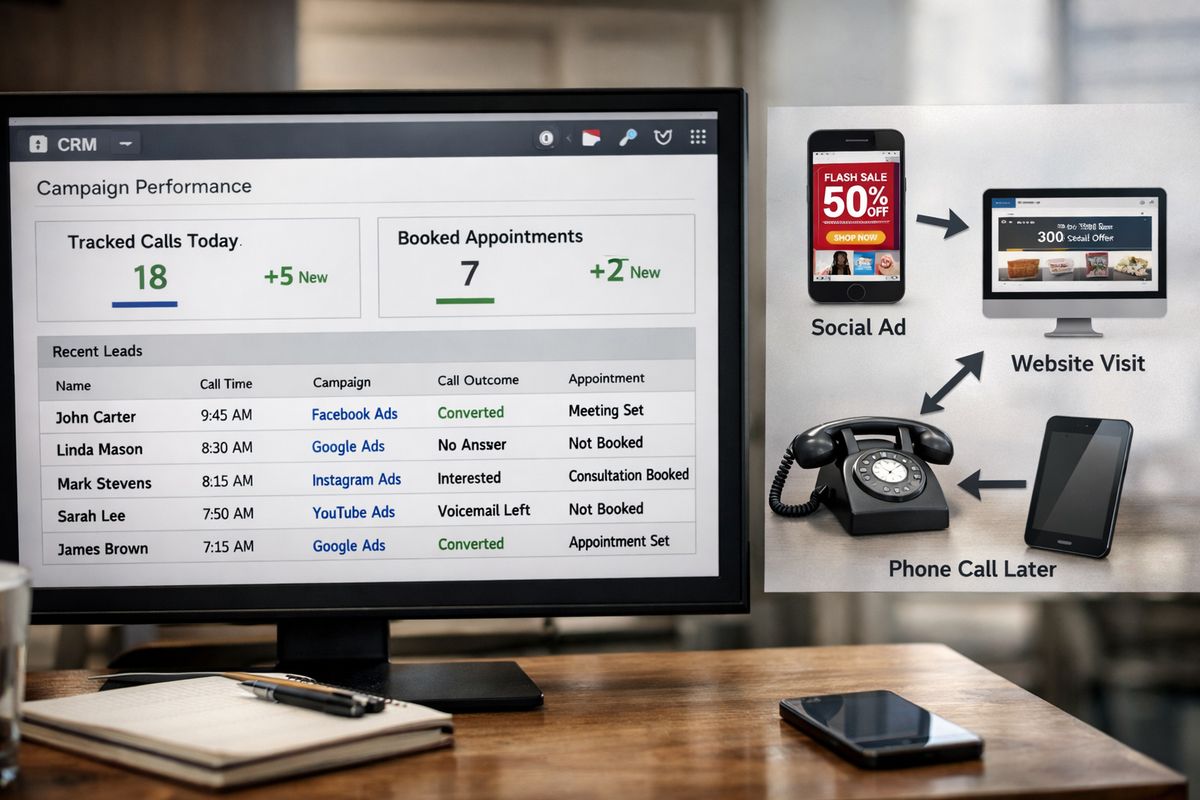
You can track calls from ads, calls from landing pages, form fills, booked appointments, and imported offline conversions from your CRM. Keyword-level visibility also helps you understand what kind of searches actually drive revenue, not just clicks.
That makes optimization more grounded. You can trim waste, shift budget, and improve landing pages based on clearer signals. If account performance feels vague, a proper look under the hood before touching bids or budgets often reveals tracking gaps, bad search terms, and conversion issues that reports gloss over.
Facebook Ads Tracking Challenges and Opportunities
Facebook tracking has more blind spots.
Pixel data, Conversions API, instant forms, view-through reporting, and modeled attribution all play a role. A user may see an ad, visit later through Google, then convert on a different device. Facebook may claim some influence, and sometimes fairly. The challenge is proving exactly how much.
Still, Facebook can work very well if your CRM is solid and your team follows up fast. Matching leads back to appointments and revenue matters more here because platform-reported numbers can make performance look cleaner than it is.
The opportunity is that Facebook often assists conversions that another channel closes. That does not make it less valuable. It just means you need honest attribution, not flattering attribution.
Landing Pages and Conversion Experience
What happens after the click often matters more than the click itself.
Google traffic usually needs a direct, intent-matched landing page. If somebody searched for “emergency electrician,” the page should immediately confirm the service, service area, trust signals, and call-to-action. No wandering. No brand manifesto. No scavenger hunt for the phone number.
Facebook traffic often needs more warming up. Since the person was not actively searching, the landing page may need stronger proof, more explanation, better visuals, financing details, testimonials, or a softer step like a quiz, guide, or consultation request.
In plain English, search traffic wants an answer. Social traffic often wants reassurance first.
Retargeting and Repeat Visibility
Retargeting is where the two platforms stop competing and start helping each other.
Google can retarget past visitors across Display, YouTube, and other inventory. Facebook can retarget site visitors, video viewers, engaged users, and past leads with strong repeat visibility inside familiar feeds. Both can keep your business top of mind after somebody visits but does not contact you.
Facebook often feels especially strong here because repeated feed exposure can build familiarity without requiring another search. Somebody who clicked your Google ad on Monday may be more likely to remember you after seeing a testimonial or project photo on Facebook on Wednesday.
Retargeting works best when it supports a primary acquisition channel, not when it tries to exist on its own. You need traffic first. Then retargeting multiplies its value.
Scalability and Long-Term Growth
Scaling looks different on each platform.
Google has a natural ceiling because search volume is finite. There are only so many people searching for “roof repair Gainesville” in a given month. Once you capture a healthy share of those searches, growth gets harder. You can expand into nearby markets, adjacent services, stronger landing pages, or broader match coverage, but there is still a demand ceiling.
Facebook has broader top-of-funnel scale, but that comes with trade-offs. As budgets rise, creative fatigue can hit, frequency can climb, and weaker audiences can dilute results. You may reach more people, but not all additional reach is equally useful.
Sustainable growth usually means treating Google as the intent engine and Facebook as the visibility engine. One scales depth. The other scales breadth.
Ease of Management and Optimization
Neither platform is set-and-forget, despite what plenty of sales pitches imply.
Google requires search term review, negative keyword management, bid strategy oversight, extension upkeep, landing page testing, and close attention to lead quality by campaign. Automation has improved, but sloppy oversight still burns cash. If you need a sense of what serious ongoing hands-on paid search management is supposed to include, look at the work behind the reports, not just the graphs.
Facebook demands a different kind of discipline. You need fresh creative, audience testing, frequency control, offer adjustments, and close monitoring of lead quality. The optimization work is often less about keyword cleanup and more about messaging, visuals, and conversion follow-up.
Google is usually easier to explain. Facebook is usually harder to master consistently without strong creative and sales ops.
Pricing and Budget Recommendations
Budget should match the job you want the platform to do.
If you expect Google to dominate a competitive market on a shoestring, performance will look worse than it should. If you expect Facebook to reveal a winning audience and creative angle on a tiny test budget, you may never get enough data to know whether the offer actually works.
Suggested Starting Budget for Google Ads
For many local service businesses, a workable Google Ads budget starts in the range that can buy enough qualified clicks to generate meaningful data each month. In less competitive niches, that may be manageable with a modest spend. In roofing, legal, HVAC, and other high-pressure categories, the number needs to be higher.
The main point is simple: underfunded search campaigns often look broken when the real problem is lack of volume. If you can only afford a handful of clicks per week in a market where every click costs serious money, optimization becomes guesswork.
A practical starting budget should cover traffic, testing, and enough runway to evaluate lead quality, not just click volume.
Suggested Starting Budget for Facebook Ads
Facebook also needs room to learn.
If your budget is too small, the platform struggles to test creative, find patterns, and move past noisy early results. That is especially true if your offer has a longer sales cycle or your service area is limited. Very small budgets can make good offers look weak simply because the campaign never gathered enough signal.
Facebook budgets should account for creative production too, not just media spend. If the campaign depends on fresh images, video, testimonials, and offer variations, that production cost is part of the real budget whether anybody likes it or not.
When Google Ads Is the Better Choice
Google Ads is the better choice when your customers already know they need help and are likely to search for it.
That includes urgent home services, legal services, local medical and dental searches, high-intent estimate requests, and businesses that care most about direct lead capture with clearer accountability. It also fits businesses with tighter budgets that cannot afford months of awareness testing before results become obvious.
If you need the phone to ring, if your office can answer quickly, and if your service solves an immediate problem, Google should usually come first. That is the clearest answer in this entire comparison.
When Facebook Ads Is the Better Choice
Facebook Ads is the better choice when your offer benefits from visuals, repetition, financing angles, education, or emotional appeal.
That includes remodeling, med spas, aesthetics, elective treatments, events, promotions, and seasonal campaigns where attention has to be created rather than captured. It also works well for businesses with a sales process built to nurture leads over time instead of expecting instant close rates.
If your business wins by showing transformations, building familiarity, or staying visible before somebody is ready, Facebook can be the stronger channel.
When Using Both Together Makes the Most Sense
Using both makes sense once you understand each platform’s job.
Google should capture high-intent searches from people ready to act. Facebook should follow up with past visitors, promote proof, reinforce your brand, and create demand among colder audiences who may need more time.
That combination often works especially well for roofers, remodelers, med spas, and multi-location service brands. Google harvests demand. Facebook keeps your name warm. Together, the system feels less like gambling and more like an actual pipeline.
The mistake is treating both channels as if they should perform the same way. They should not. Different traffic, different psychology, different expectations.
Verdict: Which Channel Fits Your Business in 2026?
For most local service businesses in 2026, Google Ads is the winner.
Not because Facebook is bad. Because intent beats interruption when your goal is direct lead generation, cleaner tracking, and faster proof of ROI. If your business depends on people searching for help now, Google is usually the better first channel. Facebook is the better support channel unless your offer is highly visual, trust-heavy, or needs demand creation before somebody would ever search.
That is the simple rule. Start with the channel that matches buying behavior, not the one with prettier front-end metrics.
Best Overall Winner
Google Ads is the best overall winner for most local service businesses.
The reason is straightforward: stronger intent, clearer attribution, better alignment with urgent searches, and a shorter path from click to call. If you want a channel that usually makes it easier to see what worked and what did not, Google gives you that visibility.
For a business owner who values transparency, accountability, and real ROI over flashy reporting, that matters a lot.
Best Pick by Business Type
Local contractors, roofers, plumbers, HVAC companies, electricians, attorneys, and other high-intent service providers should usually start with Google Ads. That is especially true when leads need to turn into booked jobs quickly.
Med spas, cosmetic practices, remodelers, and visually driven services often benefit from Facebook earlier because transformation, trust, and financing offers are easier to sell through creative and repetition.
Ecommerce brands can go either direction depending on product demand, branded search volume, and margin structure, though Facebook often plays a bigger prospecting role there than it does for local services.
Businesses with longer sales cycles should still take Google seriously if search intent exists, but adding Facebook for retargeting and nurture usually improves conversion rates over time.
If you need one practical move, start by matching your channel to your buyer’s moment. Search demand gets Google first. Curiosity, aspiration, and trust-building get Facebook support. That one decision fixes a lot.